You know the exact moment. The one where making stuff stopped being yours.
For some people it was a post they actually loved — poured something real into it — and watched the algorithm shrug and move on. For others it was more insidious. Catching yourself angling your phone over a plate of food before you'd even picked up a fork. Or cracking open a notes app to just write something and your brain, without permission, whispers: this could be a carousel.
Nobody warns you about that moment. The internet didn't just hand us a platform. It handed us a job we never interviewed for.
The Moment "Creator" Became a Job Title Nobody Asked For
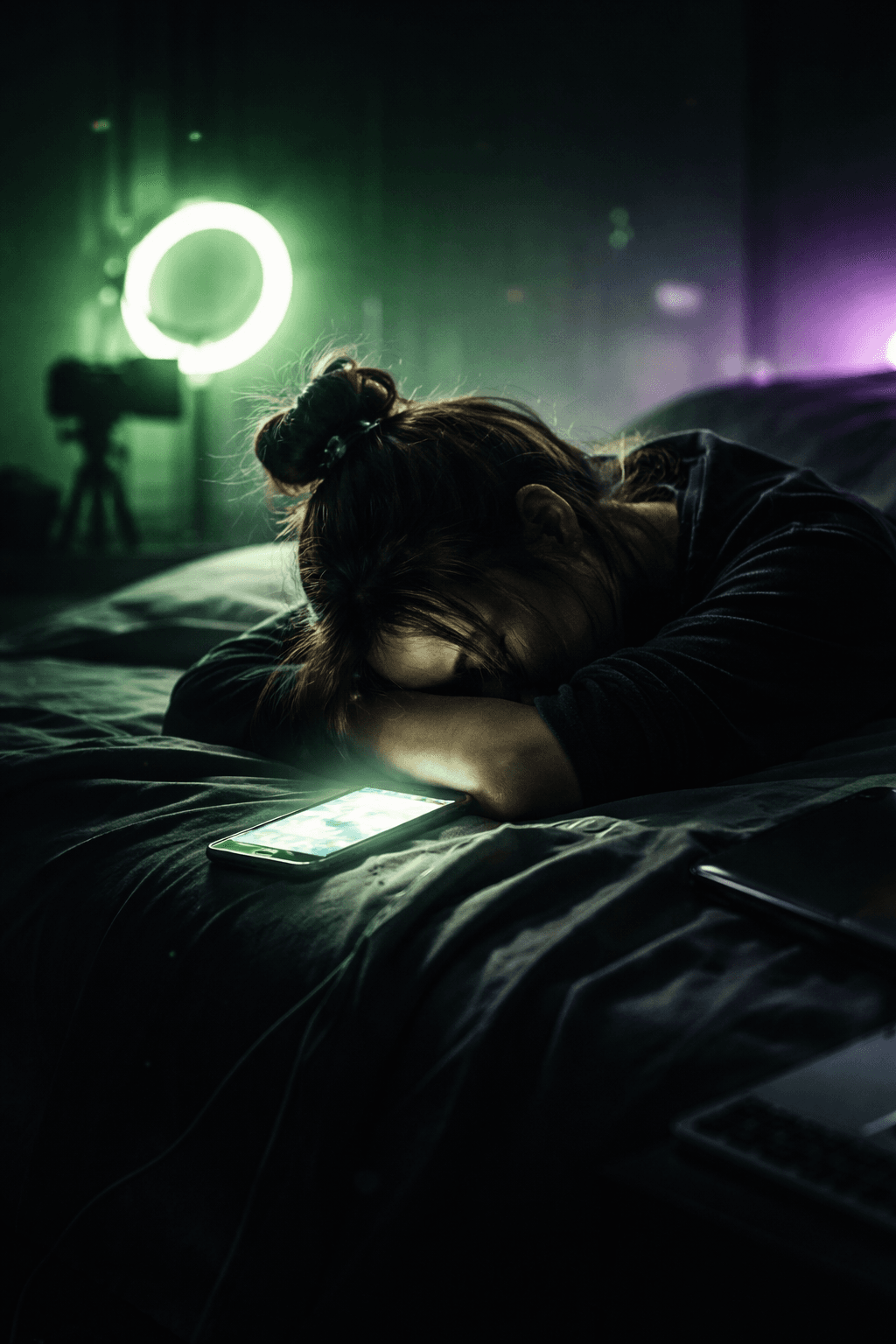
A specific kind of exhaustion is circulating in 2025 — and overwork is barely the half of it.
This is the identity kind. The who even am I without the content kind.
Creator burnout 2025 hits differently than regular burnout because the thing grinding you down is, technically, supposed to be your passion. Can't call in sick from your aesthetic. There's no PTO for your personal brand — no HR department, no "I just need a day."
So the algorithm quietly rewires you. Trains you to see yourself as a product. And then one afternoon you're sitting there with a quarterly content calendar, wondering how a human being ended up here.
The "Build Your Brand" Pipeline Was a Trap (And We All Walked Into It)
Here's the timeline most of us lived through without fully clocking it:
2019-2020: You started posting stuff you actually cared about. It was fun. Maybe it was book reviews, maybe it was cooking experiments, maybe it was just your unhinged thoughts at 2am.
2021: You got a taste of traction. The comments felt good. You started thinking about consistency.
2022-2023: You downloaded a content scheduling app. You started saying things like "this era of my account" unironically.
2024: You realized you hadn't done the original thing — the thing that made you want to post in the first place — in months. Because it doesn't perform well.
2025: You're here. Reading this. Feeling seen in a way that makes you slightly uncomfortable.
Three years, roughly. That's all it takes — hobbyist to burnt-out, with zero moments of actual consent along the way.
The Grief Nobody Names
What's wild about creator burnout 2025 is that the grief part doesn't get talked about. Not really.
It's not just posting fatigue. It's mourning the pre-platform version of yourself — whoever wrote things no one would ever read, took photos that died on a camera roll, cooked something weird at midnight without once thinking about documentation.
That version of you isn't gone, exactly. But they've been so thoroughly overwritten by the content-brained version that accessing them feels like work now. Like swimming upstream in your own head.
You used to make things because making felt good.
Now — there's this reflex. Something gets made and immediately you're running it through a mental algorithm you didn't consciously install. Does it perform? Is the audience going to get it? What did that newsletter say about hook length?
The medium ate the message. And then, somewhere in there, it ate you too.
Why Quitting Feels Impossible (Even When You Want To)
Here's the thing that makes this whole situation so brutal: the sunk cost hits different when your identity is the investment.
Hours are one thing. But you didn't just put in hours — you constructed an entire public-facing self. A version of you that lives in the feed, that people recognize, that has opinions and a vibe and a posting cadence. Quitting doesn't mean logging off.
It means sitting with the question: who am I when I'm not making content about who I am?
Genuinely terrifying, that one. Which is probably why most people don't actually quit — they go quiet instead, post every two weeks, drop a "sorry I've been MIA" that everyone relates to immediately, and then spiral back into the same cycle. Brainrot, but make it structural.
The chronically online crowd has watched this arc play out for years. We've seen it happen to people we followed. Thought we were immune. We weren't.
What's Actually Happening Right Now
Creators going quiet isn't random. This isn't just a bad month.
What's unfolding is a slow, widespread reckoning with something most of us felt but couldn't name: the creator economy was never actually built for creators. Platforms needed content. Advertisers needed eyeballs. Engagement metrics were never designed around anything resembling human flourishing — they were designed around human stickiness, which is a completely different and much darker thing.
Gen Z got sold a specific dream — turn your passion into income, beat the algorithm, make it work for you. And a lot of us are landing in 2025 with the dawning realization that the algorithm was never working for us. Not really.
Not entirely played. Not irreversibly. But... enough.
The Honest Part (The Part That Actually Matters)
If you read the wave of burned-out creators stepping back charitably — and you should — here's what it actually signals:
People are choosing themselves over their metrics.
That's not failure. Growth looks like that sometimes. In 2025, the most anti-algorithm move available to you is deciding your creative energy belongs to you first, your audience somewhere after that, and the platform not at all.
The people stepping back aren't quitting making things. They're quitting making things for the machine — and that distinction is everything.
Creator burnout 2025 is real and it's widespread, and it's swallowing the people who cared most, who tried hardest, who bought in most completely. But underneath all of it there's a signal worth reading — a loud, exhausted signal that the whole setup had a flaw baked in from day one.
You didn't fail the algorithm.
The algorithm failed you.
And maybe the most honest thing the internet has managed in years is letting enough of us burn out simultaneously that we can finally just... say that.