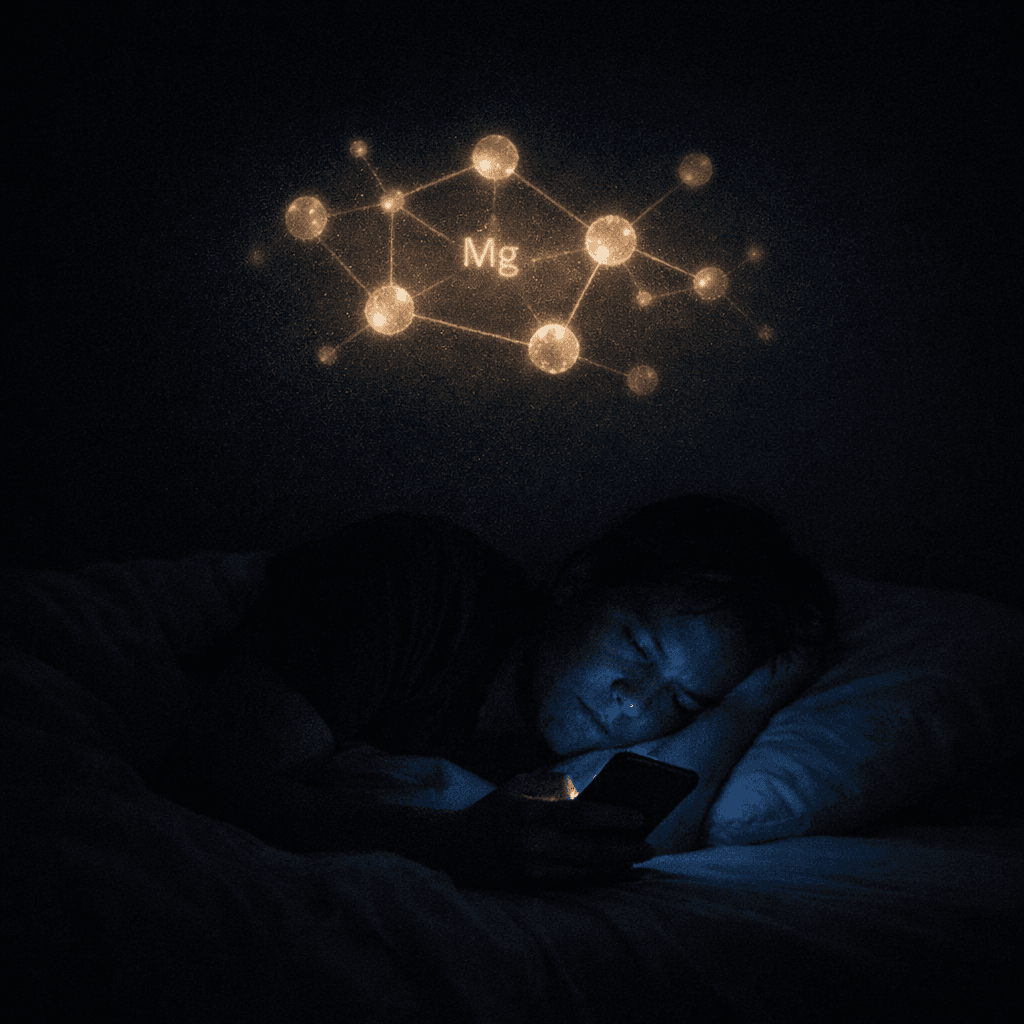
It's 3 AM. You know this because you just checked your phone for the fourth time tonight, the blue light burning your eyes in the dark. You've been asleep — technically — but you keep jolting awake. Restless. Your legs are doing that thing. Your mind isn't even racing with thoughts, it just... won't switch off. And tomorrow you'll drag yourself through the day like a person wearing a suit made of wet concrete, wondering what's wrong with you.
Nothing dramatic is wrong with you. But something surprisingly simple might be. Before you go down the rabbit hole of cortisol dysregulation, circadian rhythm disorders, or sleep apnea — which are all valid things — let's talk about a mineral so quietly essential, so overlooked, that researchers have started calling it the "the original chill pill." We're talking about magnesium.
The Mineral Your Body Desperately Needs (And Probably Isn't Getting)
Here's a stat that should keep you up at night — though honestly, something probably already is. Studies suggest that roughly 48% of Americans don't meet the daily recommended intake of magnesium. Some estimates push that number even higher. And the cruel irony? The more stressed you are, the more magnesium your body burns through. The more sleep-deprived you are, the harder it is to replenish it. It's a vicious cycle wearing a very polite mask.
Magnesium is involved in over 300 enzymatic reactions in the human body. It regulates your nervous system, helps produce energy, controls muscle function, and — here's the part relevant to you, lying awake at 3 AM — it plays a starring role in how you sleep. And not just how long you sleep, but how deeply you sleep, and whether you actually stay asleep.
Key Numbers:
48% of Americans are magnesium deficient
300+ biochemical reactions rely on magnesium
~400mg daily recommended intake for adults
56% increase in insomnia risk when deficient
"Think of magnesium as the body's natural dimmer switch — without it, your nervous system doesn't know how to turn the lights down at night."
So What Does Magnesium Actually Do For Sleep?
Let's get into the beautiful, slightly nerdy science of it — but in a way that actually makes sense. Your brain has this neurotransmitter called GABA (gamma-aminobutyric acid). GABA is essentially your brain's "shhh, calm down" chemical. It slows neural activity. Without enough GABA doing its job, your brain just keeps firing. You've felt this — that irritating, meaningless wakefulness where you're not anxious about anything specific, you're just... awake. Annoyingly, pointlessly awake.
Magnesium binds to GABA receptors and activates them. No magnesium? Your GABA receptors sit there underperforming like an understaffed help desk. Your nervous system stays in a state of low-level over-activation. The result: lighter sleep, more frequent wake-ups, and that deeply unsatisfying feeling of having 'slept' eight hours but feeling like you napped in an airport.
On the flip side, magnesium also blocks NMDA receptors — the receptors that stimulate the nervous system. So it's doing double duty: amplifying your calming signals while simultaneously dampening your excitatory ones. It is, genuinely, a biochemical sleep aid that your body was designed to use. You just might not be giving it enough to work with.
Does This Sound Like You? Signs You Might Be Deficient
You wake up multiple times during the night for no clear reason
Restless legs or muscle cramps that wake you up or stop you from falling asleep
You feel tired even after a 'full night' of sleep
Tension headaches, especially in the morning
Anxiety that spikes at night when the world goes quiet
Constipation, low energy, or an irritability you can't quite explain
You eat mostly processed foods and don't often get leafy greens, nuts, or seeds
The Restless Leg Problem Is Real — And Magnesium Might Fix It
If you've ever had the deeply maddening experience of lying down, finally, after a long day, only to feel this creeping, crawling, urgent need to move your legs — you know the specific torture of restless leg syndrome. It's hard to describe to people who haven't experienced it. It doesn't quite hurt. It's just relentlessly uncomfortable. Like your legs forgot that the rest of you is trying to sleep.
Magnesium deficiency is one of the most commonly cited nutritional contributors to restless legs. The mineral is critical for muscle relaxation — it works in opposition to calcium, which triggers muscle contraction. When your magnesium levels are low, muscles can't fully release. They stay in a low-grade state of tension. Which is why that warm bath you instinctively draw yourself sometimes helps — heat encourages blood flow and helps muscles relax in the absence of enough magnesium to do it biochemically.
Why Are So Many of Us Deficient?
This is where it gets a little grim — but also weirdly validating. It's not just about diet, though diet matters enormously. Modern agricultural practices have depleted the magnesium content of soil over decades, meaning the spinach and almonds you eat today contain meaningfully less magnesium than the same foods did fifty years ago. You're not imagining it. The food chain genuinely delivers less of this mineral than it used to.
Add to that: alcohol strips magnesium from the body. So does caffeine — your morning (and let's be honest, afternoon) coffee is literally flushing it out. High sugar diets increase its excretion through urine. Chronic stress depletes it rapidly because cortisol essentially spends magnesium like it's on sale. And many common medications — including proton pump inhibitors, diuretics, and certain antibiotics — interfere with absorption or increase loss.
In other words, if you live a modern, stressed, coffee-drinking, occasionally wine-fueled life and don't religiously eat nuts, seeds, dark leafy greens, legumes, and whole grains every single day, you are quite possibly running low on magnesium. Welcome to the club. The membership is enormous.
"Stress depletes magnesium. Magnesium deficiency amplifies your stress response. It's the kind of loop that could only have been designed by someone deeply committed to making your evenings worse."
How Do You Fix It?
The good news — and there really is good news — is that magnesium is one of the more straightforward deficiencies to address. Start with food. Pumpkin seeds are one of the richest sources around. Dark chocolate (70% or higher) is a genuinely useful reason to eat dark chocolate. Spinach, almonds, cashews, black beans, avocado, and banana are all solid sources that are easy enough to incorporate daily.
If food isn't cutting it — and for many people, supplementation becomes necessary — the form of magnesium you choose actually matters a lot. Not all magnesium supplements are created equal, and this is where people often waste money buying the wrong thing.
Forms of Magnesium & What They're Best For:
Magnesium Glycinate — Best for sleep and anxiety. Highly bioavailable, gentle on the stomach, doesn't cause the laxative effect that puts people off magnesium supplements.
Magnesium L-Threonate — Best for cognitive effects and sleep quality. Crosses the blood-brain barrier uniquely well. Premium, but genuinely different.
Magnesium Citrate — Good general absorption, mild laxative effect. Fine for general use, less ideal if you're already running to the bathroom at night.
Magnesium Oxide — Cheap, widely available, poorly absorbed. Skip it unless a doctor has specifically recommended it.
Magnesium Oil / Topical Sprays — Absorbed through the skin, useful if you have digestive sensitivity.
The general dosage for sleep support ranges from 200–400mg, taken about an hour before bed. As always, talk to a doctor before starting any supplement — especially if you have kidney disease.
What Can You Realistically Expect?
This is important, because wellness culture loves to oversell. Magnesium is not a knockout pill. It won't seduce you into unconsciousness the first night you take it. What most people report — after consistent supplementation over one to three weeks — is a quieter nervous system at bedtime. Fewer awakenings. That satisfying, heavy-limbed feeling of genuinely restful sleep that you might have forgotten was even possible. The sense of waking up and actually feeling like you slept.
Some people notice the difference within days. Others take longer. But the evidence base is genuinely solid here. A 2012 randomized controlled trial published in the Journal of Research in Medical Sciences found that magnesium supplementation significantly improved sleep efficiency, sleep time, and early morning awakening in elderly adults with insomnia. Multiple studies have since reinforced this link across age groups.
It's not magic. But it might be the most underrated, underused, perfectly legal, completely available tool in your sleep toolkit — and the fact that we're all walking around deficient in it while billion-dollar pharmaceutical companies sell us sleep aids with alarming side effects is, frankly, a little absurd.
One Last Thing, From One 3 AM Scroller to Another
Sleep deprivation is one of those things that sneaks up on you. You start to normalize feeling exhausted. You tell people 'I'm just not a good sleeper' as though it's a personality trait rather than a physiological problem worth solving. You caffeinate harder in the morning, wind down later at night, and the cycle compounds.
Before you resign yourself to a lifetime of fractured, unsatisfying sleep — check the basics. Are you eating foods that support your nervous system? Are you giving your body what it needs to actually wind down? Sometimes the answer isn't a complicated protocol or an expensive treatment. Sometimes it's a mineral your soil forgot to put in your spinach.
Go get some sleep. You deserve it. The internet will still be here in the morning — probably making you just as anxious as it is right now, but at least you'll face it rested.
Disclaimer: This article is for informational purposes only and does not constitute medical advice. Always consult a qualified healthcare provider before starting any new supplement, especially if you have existing health conditions or are on medication. Individual results vary.